

Alexander The Great In The Quran
The idea
The idea: the Quran’s Dhul-Qarnayn is Alexander the Great, and his story in Q 18:83–98 retells an Alexander tradition that was already known around Muhammad.
The Quran itself says people were already asking about him. Its details match an older Syriac Alexander Legend: horns, a sea at the sunset, and an iron gate against Gog and Magog.
Follow the chart down to the conclusion.
The short version
Dhul-Qarnayn is Alexander the Great.
John Renard, Encyclopaedia of the Qur’an, vol. 1 (2001), p. 61
Traditional and modern scholars have identified the figure the Qur’an refers to as the Possessor of the Two Horns (Dhu l-Qarnayn …) as Alexander the Great
People were already asking about him.
Qur’an 18:83 (Sahih International, via alquran.cloud)
And they ask you, [O Muhammad], about Dhul-Qarnayn. Say, “I will recite to you about him a report.”
The details match an older Alexander legend: horns, a sea at sunset, and an iron gate against Gog and Magog.
Qur’an 18:86 and 18:94 (Sahih International, via alquran.cloud); Syriac Alexander Legend, as translated on the page (van Bladel 2008; Budge 1889, p. 153)
Until, when he reached the setting of the sun, he found it [as if] setting in a spring of dark mud, and he found near it a people. (Q 18:86)
I caused horns of iron to grow on your head, so that you may gore with them the kingdoms of the world.
They said, “O Dhul-Qarnayn, indeed Gog and Magog are [great] corrupters in the land. So may we assign for you an expenditure that you might make between us and them a barrier?” (Q 18:94)
Classical Muslim scholars said he is Alexander.
John Renard, Encyclopaedia of the Qur’an, vol. 1 (2001), p. 61
Traditional and modern scholars have identified the figure the Qur’an refers to as the Possessor of the Two Horns (Dhu l-Qarnayn …) as Alexander the Great
Conclusion
The story likely comes from an Alexander tradition already known around Muhammad.
Qur’an 18:83 (Sahih International, via alquran.cloud)
And they ask you, [O Muhammad], about Dhul-Qarnayn. Say, “I will recite to you about him a report.”
▼
▼

1 of 5 · The claim
Who Dhul-Qarnayn is
Classical Muslim scholars said he is Alexander. Here is what that rests on.
Who is Dhul-Qarnayn?
Muslims routinely recast famous historical figures as Muslims: Jesus, Moses, Abraham, Adam and the rest. They do the same with Alexander the Great.
Classical scholars such as al-Tabari and Fakhr al-Din al-Razi identified him as the Quran’s Dhul-Qarnayn, whose story is bound up with Islamic end-times belief. Most Muslims deny it today. Renard 2001, p. 61
The Quran never names Alexander. “Dhul-Qarnayn” means “the two-horned.” Some early scholars proposed a pre-Islamic king of south Arabia or Persia instead. Budge 1889, p. 147 n. 1
Sources
Alexander is the traditional identification of Dhul-Qarnayn
Renard, J., “Alexander,” in Encyclopaedia of the Qur’an 1 (Brill, 2001), p. 61: “Traditional and modern scholars have identified the figure the Qur’an refers to as the Possessor of the Two Horns (Dhu l-Qarnayn …) as Alexander the Great … Anomalously, some early scholars saw the epithet as reference to a pre-Islamic monarch of south Arabia or Persia.”
The Quran does not name Alexander; the Muslim candidates were Alexander, a Persian king or a Yemeni king
Budge, E. A. W. (ed. and trans.), The History of Alexander the Great, being the Syriac Version of the Pseudo-Callisthenes (Cambridge University Press, 1889), p. 147 n. 1 (the name “two horned”; lists Alexander, a Persian king and a Yemeni king as the Muslim candidates). Scan on archive.org
Objections and our answers
Objection: The Quran never says Dhul-Qarnayn is Alexander.
Our answer: True. The identification comes from classical scholars, and it rests on the story’s details, which match the Alexander Legend. Renard 2001, p. 61
Objection: Most Muslims deny it today.
Our answer: The point here is the classical scholarship and the matching details, not what is believed now.
▼

2 of 5 · The Quran’s own wording
“They ask you about Dhul-Qarnayn”
The strongest evidence is in the verse itself.
The Quran itself says the story was already known
Qur’an 18:83 (Sahih International, via alquran.cloud)
And they ask you, [O Muhammad], about Dhul-Qarnayn. Say, ‘I will recite to you about him a report.’
The people asking already knew of him. The Quran answers a question about a figure the questioners had heard of.
Sources
The Quran itself says the story was already known
Qur’an 18:83 (Sahih International translation, via alquran.cloud): “And they ask you, [O Muhammad], about Dhul-Qarnayn. Say, ‘I will recite to you about him a report.’”
Qur’an 18:83 (Pickthall translation, via alquran.cloud): “They will ask thee of Dhu’l-Qarneyn. Say: I shall recite unto you a remembrance of him.”
▼
The occasion, as Ibn Ishaq tells it
Jewish rabbis in Medina told the Quraysh to test Muhammad with three questions: the young men who “disappeared in ancient days,” “the mighty traveller who reached the confines of both East and West,” and the spirit. Guillaume pp. 136–137
Sources
The occasion: the Quraysh asked, on the rabbis’ advice
Guillaume, The Life of Muhammad (translation of Ibn Ishaq; Oxford University Press, 1955), p. 136: the rabbis of Medina tell the Quraysh to ask “what happened to the young men who disappeared in ancient days, for they have a marvellous story,” “the mighty traveller who reached the confines of both East and West,” and “what the spirit is”; p. 137: the Chapter of The Cave then “told him the answers of their questions, the youths, the mighty traveller, and the spirit”. Full text on archive.org
Ibn Ishaq died c. 768 CE (Guillaume p. xiii gives 151 AH), about 136 years after Muhammad’s death, so this is a later report of the occasion.
▼
Muhammad took 15 days to answer
He said he would answer “tomorrow.” Ibn Ishaq says he then waited fifteen days with no revelation, and Meccans said “today is the fifteenth day we have remained without an answer.” Then the Chapter of The Cave came and “told him the answers of their questions, the youths, the mighty traveller, and the spirit.” Guillaume pp. 136–137
Sources
He promised an answer for the next day and waited fifteen days
Guillaume, The Life of Muhammad (translation of Ibn Ishaq; Oxford University Press, 1955), p. 136: “I will give you your answer tomorrow”; he “waited for fifteen days without a revelation”; p. 137: “today is the fifteenth day we have remained without an answer” and then the Chapter of The Cave “told him the answers of their questions, the youths, the mighty traveller, and the spirit”. Full text on archive.org
Ibn Ishaq died c. 768 CE (Guillaume p. xiii gives 151 AH), about 136 years after Muhammad’s death, so this is a later report of the occasion.
Objections and our answers
Objection: The Quran says Muhammad did not know such stories: “You knew it not, neither you nor your people, before this” (Q 11:49; see also Q 3:44).
Our answer: Q 18:83 shows the questioners knew of Dhul-Qarnayn. It does not show where Muhammad got the story. Those verses are the Quran’s own claim, not independent evidence. Q 11:49
Objection: Ibn Ishaq wrote about 136 years after Muhammad.
Our answer: Yes, so it is a later report of the occasion. The Quran’s own words in Q 18:83 stand without it. Guillaume p. xiii
▼
3 of 5 · The older story
The Syriac Alexander Legend, step by step
The story in the order the Legend tells it, with the Quran verse each part matches.
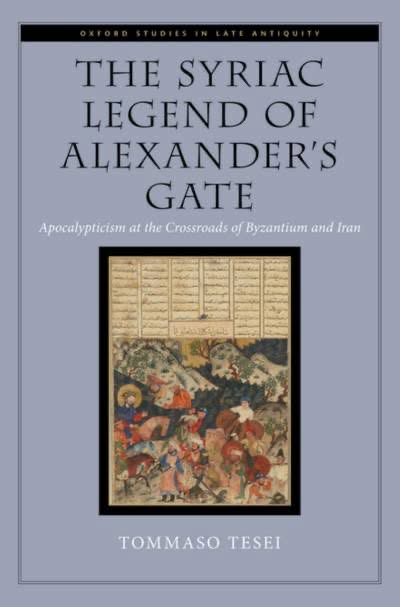
The Syriac Alexander Legend
English translation of the Neṣḥānā d-Aleksandrōs (according to Budge’s critical edition). It tells how Alexander went out to the ends of the world and made a gate of iron against the Huns. Each step below has the matching Quran verse and the passage itself.
Qur’an 18:86 and 18:94 (Sahih International, via alquran.cloud); Syriac Alexander Legend, as translated on the page (van Bladel 2008; Budge 1889, p. 153)
Until, when he reached the setting of the sun, he found it [as if] setting in a spring of dark mud, and he found near it a people. (Q 18:86)
I caused horns of iron to grow on your head, so that you may gore with them the kingdoms of the world.
They said, “O Dhul-Qarnayn, indeed Gog and Magog are [great] corrupters in the land. So may we assign for you an expenditure that you might make between us and them a barrier?” (Q 18:94)
Sources
The Legend and its translation
Budge, E. A. W. (ed. and trans.), The History of Alexander the Great, being the Syriac Version of the Pseudo-Callisthenes (Cambridge University Press, 1889), pp. 144–158 (the Legend). Scan on archive.org
Tesei, T., The Syriac Legend of Alexander’s Gate: Apocalypticism at the Crossroads of Byzantium and Iran (Oxford Studies in Late Antiquity; book cover shown).
The Legend and the Quran match point for point
van Bladel, K., “The Alexander Legend in the Qur’an 18:83–102,” in G. S. Reynolds (ed.), The Qur’an in Its Historical Context (Routledge, 2008), pp. 175–203, at pp. 177–181 (west, east, north, then the end prophecy).
1 · Alexander sets out to see the end of the world
Alexander wants to know what holds up the heavens and what surrounds the earth. His nobles warn him that a fetid sea, with waters “like pus,” stops every ship and kills whatever touches it. He decides to go anyway.
Matches the Quran
A fetid sea at the world’s edge → Q 18:86 (the sun sets “in a spring of dark mud”). van Bladel 2008, pp. 178, 181–182
Passage from the Legend
1.1 · Introduction
The victory of Alexander, son of Philip the Macedonian. How he went out to the ends of the world and made a gate of iron, which he closed in front of the wind of the north so that the Huns could not come out and plunder the countries. From the writings in the archives of the kings of Alexandria.
1.2 · Alexander Wants To Discover How The World Works
told him: “Speak, wise king of the Greeks, and whatever you command us will be accomplished.” Alexander told them: “This thought came to my mind, and I am seized by amazement: what is the extent of the earth and what the height of heaven? How many are the countries of the other kings? And on what are heavens based? Are perhaps clouds and winds that lift them up? Or are rather columns of fire rising from the earth that support the skies so that they do not move? Or are they hung to God’s nod and do not fall? And this is what I desire to go and see: upon what the heavens lie and what surrounds the whole creation.”
1.3 · Fetid Sea Description
The nobles answered telling the king: “Command us to speak.” Alexander gave command and they spoke and told him: “My lord, concerning the thing that your majesty or your greatness wants to go and see, upon what the heavens lie and what surrounds the earth, the frightening seas that surround the world will not allow the way. Because there are eleven shining seas on which the ships of the men travel. After beyond there is dry land for about ten miles, beyond which is the fetid sea, the Ocean, that surrounds the whole creation. Men cannot approach this fetid sea, neither ships can travel on it, nor can birds fly over it. If a bird fly over it, it is hunted, it falls down, and is suffocated in it. Its waters are like pus and if men swim in it they die. The leaves of the trees bordering it are burnt by the smell of those waters, like as fire had consumed them.” The nobles said these things
1.4 · Alexander Decides To Go
so?” They replied: “Yes, wise king. Because the same thought that came to your majesty’s mind also came to ours. We went to see what the heavens lie upon. But the fetid sea did not allow us crossing.” Alexander told them: “I do not think you are lying. But even if you went and the fetid sea did not allow you the crossing, I will also go and see by myself all the ends of heavens. And if there is a king whose lands are more than mine, I will seize his lands and kill him, even if he was from the regions from where the pillagers come out.”
Sources
The Legend’s opening and the fetid sea
Budge, E. A. W. (ed. and trans.), The History of Alexander the Great, being the Syriac Version of the Pseudo-Callisthenes (Cambridge University Press, 1889), pp. 144–158 (the Legend). Scan on archive.org
van Bladel, K., “The Alexander Legend in the Qur’an 18:83–102,” in G. S. Reynolds (ed.), The Qur’an in Its Historical Context (Routledge, 2008), pp. 175–203, at pp. 177–181.
The fetid sea matches the sunset spring
van Bladel, K., “The Alexander Legend in the Qur’an 18:83–102,” in G. S. Reynolds (ed.), The Qur’an in Its Historical Context (Routledge, 2008), pp. 175–203, at pp. 178, 181–182 (Arabic hami’a, “fetid”; the Syriac word is a synonym; translators render “dark mud”).
Qur’an 18:86 (Sahih International translation, via alquran.cloud): “Until, when he reached the setting of the sun, he found it [as if] setting in a spring of dark mud, and he found near it a people. Allah said, “O Dhul-Qarnayn, either you punish [them] or else adopt among them [a way of] goodness.””
▼
2 · He prays, and says God “caused horns to grow on my head”
Alexander prays to God, who made him great and “caused horns to grow on my head.” He promises to bow to the Messiah if he comes in his days, and to leave his silver throne in Jerusalem for him.
Matches the Quran
Horns → the name Dhul-Qarnayn, “the two-horned” (Q 18:83, 86, 94). The Quran gives the name, not the horns. van Bladel 2008, p. 180
Passage from the Legend
1.5 · Alexander’s Very Christian Prayer
King Alexander bowed, and worshipping said: “oh God, master of kings and judges, you who raise up kings and dismiss their power, I perceive with my mind that you made me great among all kings, and that you caused horns to grow on my head, so that I may gore with them the kingdoms of the world. Give me the power from the heavens of your sanctity so that I may receive strength greater than the kingdoms of the world, and I will humiliate them and glorify your name forever, oh Lord! Your remembrance will stay forever and ever. I will write your name, oh God, on the papers of my kingdom so that there may be always a memorial for you. And if the Messiah, who is the son of God, comes during my days, I will bow in front of him, me and my troops. And if he does not come during my days, once I will have gone and defeated kings and seized their lands, I will bring and set in Jerusalem this throne that is a chair of silver on which I sit. And when the Messiah comes from heaven he will sit on my throne, because his kingdom will stand forever. And seven hundred pounds of gold will be the gift put before the Messiah at his arrival. And whether I die in one of the regions of the world or here in Alexandria, the crown of my kingdom will be taken and lifted upon the throne, which I offer to the Messiah.”
Sources
The horns and the name Dhul-Qarnayn
van Bladel, K., “The Alexander Legend in the Qur’an 18:83–102,” in G. S. Reynolds (ed.), The Qur’an in Its Historical Context (Routledge, 2008), pp. 175–203, at p. 180 (God gives Alexander horns, the second “of iron”).
Budge, E. A. W. (ed. and trans.), The History of Alexander the Great, being the Syriac Version of the Pseudo-Callisthenes (Cambridge University Press, 1889), p. 147 n. 1 (the name “two horned”; lists Alexander, a Persian king and a Yemeni king as the Muslim candidates). Scan on archive.org
▼
3 · Blacksmiths from Egypt, and a first try that fails
The king of Egypt gives Alexander seven thousand blacksmiths. At the fetid sea, thirty-seven condemned men sent ahead die at once, and Alexander withdraws.
Passage from the Legend
1.6 · Request To Bring Blacksmiths
And they went out and moved to Mount Sinai where they encamped and rested. And they put the ships to the sea and crossed over to Egypt, that is, Aegyptus. Watchmen went up to observe whether the seas and their waves could be seen or not. And the commanders of the army said: “King Alexander, since the troop cannot proceed without blacksmiths, command that they come with us from Egypt, because on the surface of the earth there are not such blacksmiths as those from Egypt.” Alexander called Sarnaqōs, king of Egypt, and told him: “Give me seven thousand blacksmiths, workers in bronze and iron, who may come with me. And when I come back from the regions where I am going, if they desire to be returned hither, I will send them back. And if they desire to remain in one of the regions under the rule of my kingdom, I will allow them. They will not pay tribute to the king, but they will give us a customs duty.” Sarnaqōs, king of Egypt, selected seven thousand men, workers of bronze and iron, and gave them to Alexander. Then the two kings ate bread together.
1.7 · First Way Fails
Then they put the ships down to sea and traveled over it for four months and twelve days, until they arrived at the dry land that is beyond the eleven bright seas. Alexander and his troops encamped. And he sent and summoned the commander who was in the camp and told him: “Are there any men here who are sentenced to death?” The commander told him: “There are thirty- seven men among our prisoners who are sentenced to death.” And the king told the commander: “Bring here those evildoers.” When they brought them, the king commanded them and said: “Go to the shore of the fetid sea and pitch poles to tie the ships. And arrange everything which is required for an army that is crossing over the sea.” The men went and arrived at the bank of the sea. Alexander had thought: “If it is true, as they say, that everyone who gets close to the fetid sea dies, then it is better it be those who are sentenced to death to die.” The prisoners went and when they reached the seashore they died at once. Alexander and his troop were watching them dying since he and his nobles had mounted on their horses to see what would happen to them. And they saw that they died at once when they reached the sea. King Alexander was frightened and withdrew, for he knew that they could not cross to the ends of heavens
Sources
The blacksmiths and the first attempt
Budge, E. A. W. (ed. and trans.), The History of Alexander the Great, being the Syriac Version of the Pseudo-Callisthenes (Cambridge University Press, 1889), pp. 144–158 (the Legend). Scan on archive.org
▼
4 · The sun’s journey to the window of heaven
The army travels to where the Sun enters “the window of heaven.” People near its path flee into caves, because the stones burnt by its flames roll down and incinerate whatever they touch.
Matches the Quran
The sun sets at murky water → Q 18:86, and a people have no shelter from the rising sun → Q 18:90. van Bladel 2008, p. 178
Passage from the Legend
1.8 · Sun’s Journey
The whole camp mounted. Alexander and his troop set out between the fetid sea and the shining sea until reaching the place where the Sun enters the window of heaven—because the Sun is the servant of the Lord and never interrupts its journey, at neither night nor day. The place from where it rises is above the sea. When it is about to rise the people who dwell there flee and hide in the sea in order of not being burnt by its rays. It then crosses over the middle of heavens until reaching the place where it enters the window of heaven. Where it passes by are terrifying mountain peaks. Those who dwell there have caves dug in the rock. As soon as they see the Sun rising, men and birds flee from before it and hide in the caves, because the stones burnt by its flames roll down and incinerate at once whatever they touch, be it humans or beasts. As soon as the Sun enters the window of heaven it prostrates before God and venerates his creator. He then travels and descends the entire night in the skies until it finds itself at the place where it rises.
Sources
The sun’s journey
van Bladel, K., “The Alexander Legend in the Qur’an 18:83–102,” in G. S. Reynolds (ed.), The Qur’an in Its Historical Context (Routledge, 2008), pp. 175–203, at pp. 178, 181–182.
Qur’an 18:90 (Sahih International translation, via alquran.cloud): “Until, when he came upon the rising of the sun, he found it rising on a people for whom We had not made against it any shield.”
▼
5 · The people by the mountain: the Huns, Gog and Magog
Three hundred elders say the mountain is the boundary God set between them and the Huns, whose kings are Gog and Magog. The Huns raid where the Lord’s punishment sends them.
Matches the Quran
A people ask for a barrier against Gog and Magog → Q 18:93–94. van Bladel 2008, p. 179
Passage from the Legend
1.9 · Meeting The People By The Mountain
and Bēt Zmrṭ. Alexander passed by all these lands, and after passing by the mount Mūsās he entered a valley which is called Bhy Lbtʾ. He went and encamped at the entrance of the great mountain. There is in that place a way by which the merchants access the inner regions. Alexander encamped there and dispatched heralds of peace, who rode around and proclaimed in the whole land: “The king of the Greeks has come to this land without killing, burning, or destroying. May each one remain in peace! ‘Let three hundred men elder in age be selected and let them come to my presence’— said King Alexander— ‘so that I may learn from them what I seek. And may each one remain in peace!’ ” When the people of that land heard what the heralds of peace proclaimed they were not afraid. They choose three hundred old men who went to the presence of Alexander as soon as he had encamped in the country and commanded the people not to flee before him. And when the old men of that land came before him, he asked: “Who are you? To whom do you pay tribute? And who is the king who rules over this country?” The old men answered and told the king: “This land belongs to Tūbarlaq, the king of the Persians, who is of the family of the house of ʾḥšwrḥ. It is to him that we give gold.” Alexander told them: “And for how long does this mountain descend that way?” They replied: “This mountain goes forth
1.10 · Alexander Told About The Huns Who’s Kings Are Gog And Magog
…if someone goes through them without carrying ringing bells he dies at once.” Alexander said: “This mountain is higher and more frightening than all the mountains which I have ever seen.” The old men of the region told the king: “Your majesty, my lord the king, neither us nor our fathers have ever been capable of making a single step through it. And men cannot go up from either this or that side, as this is the boundary that God has placed between us and the people who are on its other side [lit. inward from it].” Alexander said: “Who are the people who are on the other side of this mountain that we are observing? [ . . . ].” The people of the land told him: “It is the Huns.” Alexander told them: “And who are their kings?” The old men replied: “Gog and Magog. And Nwl, the…
…The fear of the Huns is terrifying for all creatures who see them. And when they go to battle, they bring a woman who is pregnant and, binding her in front of a fire that they heap up, they cook her child within her until her womb splits and the child comes out when it is cooked. And they place it in a bowl and throw water on its body, which dissolves into it. Then they take their swords, their bows, their arrows, and their spears, and dip them into this water. And to whomever this water touches it appears as if there were around him a hundred thousand horsemen; and a troop of a hundred thousand demons appears to stand by the side of each hundred men. Because their sorceries are greater than those of all kingdoms. And also of this, oh Lord, we want to persuade your greatness,” the old men said to Alexander. “The Huns do not go out to plunder except where the punishment of the Lord raises, so that the Lord kills fathers and sons and strikes the earth with his wrath, as in their battles they are more dangerous than all kings.” Alexander told the…
Sources
The Huns and their kings Gog and Magog
van Bladel, K., “The Alexander Legend in the Qur’an 18:83–102,” in G. S. Reynolds (ed.), The Qur’an in Its Historical Context (Routledge, 2008), pp. 175–203, at pp. 179–181.
Budge, E. A. W. (ed. and trans.), The History of Alexander the Great, being the Syriac Version of the Pseudo-Callisthenes (Cambridge University Press, 1889), p. 150 (Gog and Magog among the kings; page break approximate). Scan on archive.org
▼
6 · Alexander builds the gate, and God gives him horns of iron
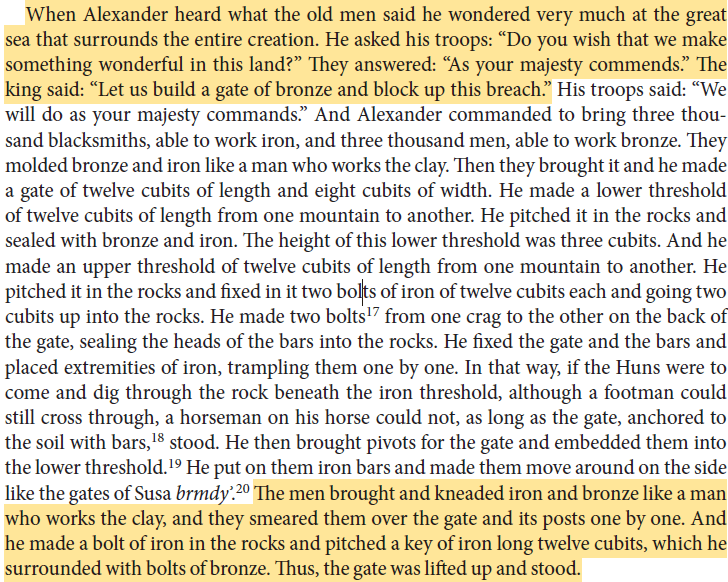
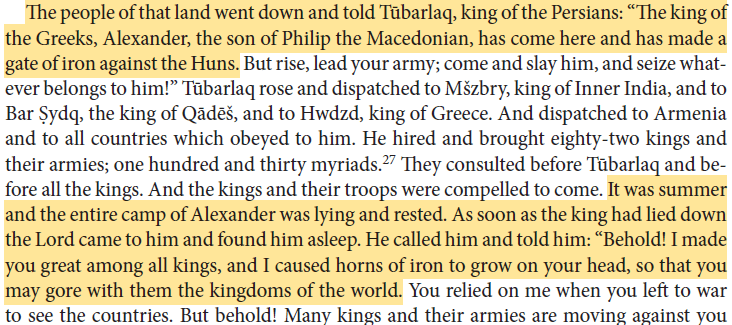
Alexander tells his troops, “Let us build a gate of bronze and block up this breach,” and has three thousand smiths work iron and three thousand work bronze. Then, as he sleeps, God tells him: “I caused horns of iron to grow on your head, so that you may gore with them the kingdoms of the world.”
Matches the Quran
A gate of iron and brass between two mountains → Q 18:93–96 (iron and molten copper). van Bladel 2008, pp. 179–181; Budge 1889, p. 153
Gog and Magog break out at the end and kings “fall upon one another” → Q 18:98–99 (the barrier is levelled; they surge over each other). van Bladel 2008, pp. 180–181
Passage from the Legend
1.11 · Alexander Decides To Build Them A Wall
1.12 · Alexander Finally Gets His 2 Horns
Sources
The gate of iron and brass
Budge, E. A. W. (ed. and trans.), The History of Alexander the Great, being the Syriac Version of the Pseudo-Callisthenes (Cambridge University Press, 1889), p. 153 (gate “from mountain to mountain,” three thousand iron smiths and three thousand brass workers). Scan on archive.org
van Bladel, K., “The Alexander Legend in the Qur’an 18:83–102,” in G. S. Reynolds (ed.), The Qur’an in Its Historical Context (Routledge, 2008), pp. 175–203, at pp. 179–181.
Qur’an 18:94 (Sahih International translation, via alquran.cloud): “They said, “O Dhul-Qarnayn, indeed Gog and Magog are [great] corrupters in the land. So may we assign for you an expenditure that you might make between us and them a barrier?””
The end-time breakout
van Bladel, K., “The Alexander Legend in the Qur’an 18:83–102,” in G. S. Reynolds (ed.), The Qur’an in Its Historical Context (Routledge, 2008), pp. 175–203, at pp. 180–181 (the inscription: the Huns break out; kings and hosts “fall upon one another”; Q 18:99 “gather them together” matches “gather together the kings and their hosts”).
Qur’an 18:99 (Sahih International translation, via alquran.cloud): “And We will leave them that day surging over each other, and [then] the Horn will be blown, and We will assemble them in [one] assembly.”
Horns of iron
van Bladel, K., “The Alexander Legend in the Qur’an 18:83–102,” in G. S. Reynolds (ed.), The Qur’an in Its Historical Context (Routledge, 2008), pp. 175–203, at p. 180.
▼
7 · The Christian ending
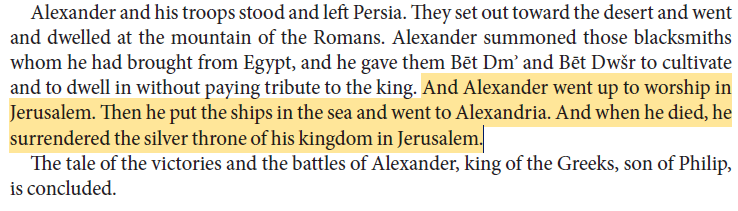
Alexander goes up to worship in Jerusalem, then sails to Alexandria. When he dies, he surrenders the silver throne of his kingdom in Jerusalem. The Legend is a Christian text, and it ends there.
Passage from the Legend
1.13 · Christian Ending
Sources
The ending
Budge, E. A. W. (ed. and trans.), The History of Alexander the Great, being the Syriac Version of the Pseudo-Callisthenes (Cambridge University Press, 1889), pp. 144–158 (the Legend; Budge calls it “A Christian Legend”). Scan on archive.org
Objections and our answers
Objection: The Quran’s version is not the same as the Legend.
Our answer: Right: it gives the name Dhul-Qarnayn but not the horns, and it has no Christian frame. But van Bladel notes that “the details of the Arabic account are all matched only by this Syriac Alexander Legend.” van Bladel 2008, p. 181
▼
4 of 5 · Dated sources
Earlier Alexander stories
Earlier texts, dated against the Quran’s traditional c. 610–632 CE.
Timeline, earliest to the Quran
Josephus, The Jewish War 7.7.4 (Whiston translation), c. 75–79 CE
The Alans treat with the king of Hyrcania to pass through it. Perseus Digital Library; CCEL
for he was master of that passage which king Alexander [the Great] shut up with iron gates.
c. 75–94 CE
Josephus: Alexander’s iron gates
What made it in
Earlier source
Iron gates shut by Alexander against Magog → Q 18:93–96 (Dhul-Qarnayn walls off Gog and Magog with iron and molten copper). Josephus, War 7.7.4; Ant. 1.6.1
Dates: Josephus c. 75–94 CE → Quran c. 610–632: ~530–555 years earlier.
Q 18:83 (see the Syriac tile) shows the Alexander story was already known.
3rd c. CE
Greek Alexander Romance (alpha)
What made it in
Earlier source
A cook’s salted fish revives in the spring of life and slips away → Q 18:61 (Moses’ fish “took its course into the sea”). The verse does not say the fish revives, so the link is an inference. Konstantakos 2017, pp. 447–448
Dates: Romance c. 3rd c. CE → Quran c. 610–632: ~330–430 years earlier.
Q 18:83 (see the Syriac tile) shows the Alexander story was already known; this fish link is separate.
514–630 CE
Syriac Alexander Legend (early core and final text)
What made it in
The Quran itself says the story was already known
“And they ask you, [O Muhammad], about Dhul-Qarnayn” → Q 18:83. Q 18:83, Sahih International
Ibn Ishaq: the Quraysh, on the rabbis’ advice, asked about “the mighty traveller who reached the confines of both East and West.” Guillaume pp. 136–137
What the Syriac text has in common with the Quran
Gate of iron and brass between two mountains against Gog and Magog → Q 18:93–96 (a barrier of iron and molten copper). van Bladel 2008, pp. 179–181; Budge 1889, p. 153
Journey to where the sun sets, a fetid sea and the Window of Heaven → Q 18:86 (the sun sets “in a spring of dark mud”). van Bladel 2008, pp. 178, 181–182
God gives Alexander horns, the second of iron → the name Dhul-Qarnayn, “the two-horned” (Q 18:83, 86, 94). The Quran gives the name, not the horns. van Bladel 2008, p. 180
Gog and Magog break out at the end and nations “fall upon one another” → Q 18:98–99 (the barrier is levelled; they surge over each other). van Bladel 2008, pp. 180–181
Dating: core c. 514–15 (Tesei; Debie 2022, p. 272 n. 7); final text often dated 629–30 (van Bladel 2008, pp. 183–184). Either way, Q 18:83 shows the story was already known to the people asking.
c. 610–632 CE
The Quran (traditional dating)
Amber: earlier source. Orange: date debated.
Sources
Josephus: War c. 75–79 CE; Antiquities c. 93–94 CE
Britannica Kids and the Latin Josephus site (search-result excerpts).
Alexander Romance, alpha recension, 3rd c. CE
Oxford Classical Dictionary; BMCR 2018 review (range 3rd c. BCE to 4th c. CE); Wikipedia, “Alexander Romance” (excerpts).
Syriac Alexander Legend: first prophecy 514–15; mainstream date 629–30; early-6th-century core
van Bladel, K., “The Alexander Legend in the Qur’an 18:83–102,” in G. S. Reynolds (ed.), The Qur’an in Its Historical Context (Routledge, 2008), pp. 175–203, at pp. 183–184, 189.
Debie, M., “Textual Exchanges in Late Antiquity East and South of Byzantium Seen Through an Eastern Christian Lens,” Proceedings of the 24th International Congress of Byzantine Studies 1 (Ca’ Foscari, 2022), pp. 259–280, p. 272 n. 7. HAL
Tesei, T., on the Neshana as a sixth-century text (2014, Miscellanea Arabica 5, pp. 273–290; 2025 preprint abstract; excerpts).
Seven Sleepers homilies, early 6th c. CE
Griffith, S., 2007, pp. 109–137; DergiPark article (excerpt).
Later versions, not used as earlier: the Greek Romance’s gate and its Gog and Magog additions are 8th–9th c. Alexander Romance, ε and γ Biblical names: Gog and Magog come from Ezekiel and Revelation. van Bladel 2008, p. 181
Sources
Later versions: the Greek gate and Gog and Magog additions
Wikipedia, “Alexander Romance” (recensions epsilon, 8th–9th c., and gamma; excerpt).
Budge, E. A. W. (ed. and trans.), The History of Alexander the Great, being the Syriac Version of the Pseudo-Callisthenes (Cambridge University Press, 1889), p. lxxvii. Scan on archive.org
The names Gog and Magog
van Bladel, K., “The Alexander Legend in the Qur’an 18:83–102,” in G. S. Reynolds (ed.), The Qur’an in Its Historical Context (Routledge, 2008), pp. 175–203, at p. 181 (the names derive from Ezekiel and the Apocalypse of John).
Objections and our answers
Objection: The Syriac Legend is dated 629–30, after the traditional Meccan date of sura 18.
Our answer: The Legend’s first prophecy is 514–15 and is not disputed, and a sixth-century core is a scholarly view. Van Bladel calls the date the story entered the Quran “undecided.” Either way, Q 18:83 shows people were already asking. van Bladel 2008, pp. 183, 191
Objection: A date shows an earlier source exists, not how it reached Muhammad.
Our answer: Agreed. Van Bladel: the Quran draws on the Legend “if not directly then by oral report.” Routes such as the Ghassanids are inference. van Bladel 2008, pp. 189–190
▼
Conclusion
Conclusion: the Dhul-Qarnayn story likely comes from an Alexander tradition already known around Muhammad.
The Quran itself says people were already asking about him. Classical Muslim scholars said he is Alexander, and the details match the Syriac Alexander Legend: horns, a sea at the sunset, an iron gate against Gog and Magog, and the end-time breakout.
The Legend’s date is debated, so the main evidence is the Quran’s own wording, not the date.
Sources
The Quran says the story was already known
Qur’an 18:83 (Sahih International translation, via alquran.cloud): “And they ask you, [O Muhammad], about Dhul-Qarnayn. Say, ‘I will recite to you about him a report.’”
Guillaume, The Life of Muhammad (translation of Ibn Ishaq; Oxford University Press, 1955), pp. 136–137. Full text on archive.org
Classical scholars identified Dhul-Qarnayn with Alexander
Renard, J., “Alexander,” in Encyclopaedia of the Qur’an 1 (Brill, 2001), p. 61: “Traditional and modern scholars have identified the figure the Qur’an refers to as the Possessor of the Two Horns (Dhu l-Qarnayn …) as Alexander the Great … Anomalously, some early scholars saw the epithet as reference to a pre-Islamic monarch of south Arabia or Persia.”
The Quran matches the Legend point for point
van Bladel, K., “The Alexander Legend in the Qur’an 18:83–102,” in G. S. Reynolds (ed.), The Qur’an in Its Historical Context (Routledge, 2008), pp. 175–203, at pp. 177–181.
